APOLLO
We pull off
to a road shack
in Massachusetts
to watch men walk
on the moon. We did
the same thing
for three two one
blast off, and now
we watch the same men
bounce in and out
of craters. I want
a Coke and a hamburger.
Because the men
are walking on the moon
which is now irrefutably
not green, not cheese,
not a shiny dime floating
in a cold blue,
the way I’d thought,
the road shack people don’t
notice we are a black
family not from there,
the way it mostly goes.
This talking through
static, bounces in space-
boots, tethered
to cords is much
stranger, stranger
even than we are.
Elizabeth Alexander
I BELIEVE
Poetry, I tell my students,
is idiosyncratic. Poetry
is where we are ourselves
(though Sterling Brown said
“Every ‘I’ is a dramatic ‘I’”),
digging in the clam flats
for the shell that snaps,
emptying the proverbial pocketbook.
Poetry is what you find
in the dirt in the corner,
overhear on the bus, God
in the details, the only way
to get from here to there.
Poetry (and now my voice is rising)
is not all love, love, love,
and I’m sorry the dog died.
Poetry (here I hear myself loudest)
is the human voice,
and are we not of interest to each other?
Elizabeth Alexander
BOSTON YEAR
My first week in Cambridge a car full of white boys
tried to run me off the road, and spit through the window,
open to ask directions. I was always asking directions
and always driving: to an Armenian market
in Watertown to buy figs and string cheese, apricots,
dark spices and olives from barrels, tubes of paste
with unreadable Arabic labels. I ate
stuffed grape leaves and watched my lips swell in the mirror.
The floors of my apartment would never come clean.
Whenever I saw other colored people
in bookshops, or museums, or cafeterias, I’d gasp,
smile shyly, but they’d disappear before I spoke.
What would I have said to them? Come with me? Take
me home? Are you my mother? No. I sat alone
in countless Chinese restaurants eating almond
cookies, sipping tea with spoons and spoons of sugar.
Popcorn and coffee was dinner. When I fainted
from migraine in the grocery store, a Portuguese
man above me mouthed: “No breakfast.” He gave me
orange juice and chocolate bars. The color red
sprang into relief singing Wagner’s Walküre.
Entire tribes gyrated and drummed in my head.
I learned the samba from a Brazilian man
so tiny, so festooned with glitter I was certain
that he slept inside a filigreed, Fabergé egg.
No one at the door: no salesmen, Mormons, meter
readers, exterminators, no Harriet Tubman,
no one. Red notes sounding in a grey trolley town.
Elizabeth Alexander
CRASH
I am the last woman off of the plane
that has crashed in a cornfield near Philly,
picking through hot metal
for my rucksack and diaper bag.
No black box, no fuselage,
just sistergirl pilot wiping soot from her eyes,
happy to be alive. Her dreadlocks
will hold the smoke for weeks.
All the white passengers bailed out
before impact, so certain a sister
couldn’t navigate the crash. O gender.
O race. O ye of little faith.
Here we are in the cornfield, bruised and dirty but alive.
I invite sistergirl pilot home for dinner
at my parents’, for my mother’s roast chicken
with gravy and rice, to celebrate.
Elizabeth Alexander
The Dirt-Eaters
“Southern Tradition of Eating Dirt Shows Signs of Waning” —headline, New York Times, 2/14/84
tra
dition
wanes
I read
from North
ern South:
D.C.
Never ate
dirt
but I lay
on Great-
grandma’s
grave
when I
was small.
“Most cultures
have passed
through
a phase
of earth-
eating
most pre
valent today
among
rural
Southern
black
women.”
Geo
phagy:
the practice
of eating
earthy matter
esp. clay
or chalk.
(Shoe-
boxed dirt
shipped North
to kin)
The gos
sips said
that my great-
grand
ma got real
pale when she
was preg
nant:
“Musta ate
chalk,
Musta ate
starch, cuz
why else
did her
babies
look
so white?”
The Ex
pert: “In ano
ther gener
ation I
sus
pect it will dis
appear al
together.”
Miss Fannie Glass
of Creuger, Miss.:
“I wish
I had
some dirt
right now.”
Her smile
famili
ar as the
smell
of
dirt.
Elizabeth Alexander
Early Cinema
According to Mister Hedges, the custodian
who called upon their parents
after young Otwiner and young Julia
were spotted at the matinee
of Rudolph Valentino in The Sheik
at the segregated Knickerbocker Theater
in the uncommon Washington December
of 1922, “Your young ladies
were misrepresenting themselves today,”
meaning, of course, that they were passing.
After coffee and no cake were finished
and Mister Hedges had buttoned his coat
against the strange evening chill,
choice words were had with Otwiner and Julia,
shame upon the family, shame upon the race.
How they’d longed to see Rudolph Valentino,
who was swarthy like a Negro, like the finest Negro man.
In The Sheik, they’d heard, he was turbaned,
whisked damsels away in a desert cloud.
They’d heard this from Lucille and Ella
who’d put on their fine frocks and French,
claiming to be “of foreign extraction”
to sneak into the Knickerbocker Theater
past the usher who knew their parents
but did not know them.
They’d heard this from Mignon and Doris
who’d painted carmine bindis on their foreheads
braided their black hair tight down the back,
and huffed, “We’ll have to take this up with the Embassy”
to the squinting ticket taker.
Otwiner and Julia were tired of Oscar Michaux,
tired of church, tired of responsibility,
rectitude, posture, grooming, modulation,
tired of homilies each way they turned,
tired of colored right and wrong.
They wanted to be whisked away.
The morning after Mister Hedges’ visit
the paperboy cried “Extra!” and Papas
shrugged camel’s hair topcoats over pressed pajamas,
and Mamas read aloud at the breakfast table,
“No Colored Killed When Roof Caves In”
at the Knickerbocker Theater
at the evening show
from a surfeit of snow on the roof.
One hundred others dead.
It appeared that God had spoken.
There was no school that day,
no movies for months after.
Elizabeth Alexander
“The female seer will burn upon this pyre”
Sylvia Plath is setting my hair
on rollers made from orange-juice cans.
The hairdo is shaped like a pyre.
My locks are improbably long.
A pyramid of lemons somehow
balances on the rickety table
where we sit, in the rented kitchen
which smells of singed naps and bergamot.
Sylvia Plath is surprisingly adept
at rolling my unruly hair.
She knows to pull it tight.
Few words.
Her flat, American belly,
her breasts in a twin sweater set,
stack of typed poems on her desk,
envelopes stamped to go by the door,
a freshly baked poppyseed cake,
kitchen safety matches, black-eyed Susans
in a cobalt jelly jar. She speaks a word,
“immolate,” then a single sentence
of prophecy. The hairdo done,
the nursery tidy, the floor swept clean
of burnt hair and bumblebee husks.
Elizabeth Alexander
Narrative: Ali
a poem in twelve rounds
My head so big
they had to pry
me out. I’m sorry
Bird (is what I call
my mother). Cassius
Marcellus Clay,
Muhammad Ali;
you can say
my name in any
language, any
continent: Ali.
2
Two photographs
of Emmett Till,
born my year,
on my birthday.
One, he’s smiling,
happy, and the other one
is after. His mother
did the bold thing,
kept the casket open,
made the thousands look upon
his bulging eyes,
his twisted neck,
her lynched black boy.
I couldn’t sleep
for thinking,
Emmett Till.
One day I went
Down to the train tracks,
found some iron
shoe-shine rests
and planted them
between the ties
and waited
for a train to come,
and watched the train
derail, and ran,
and after that
I slept at night.
3
I need to train
around people,
hear them talk,
talk back. I need
to hear the traffic,
see people in
the barbershop,
people getting
shoe shines, talking,
hear them talk,
talk back.
4
Bottom line: Olympic gold
can’t buy a black man
a Louisville hamburger
in nineteen-sixty.
Wasn’t even real gold.
I watched the river
drag the ribbon down,
red, white, and blue.
5
Laying on the bed,
praying for a wife,
in walk Sonji Roi.
Pretty little shape.
Do you like
chop suey?
Can I wash your hair
underneath
that wig?
Lay on the bed,
Girl. Lie
with me.
Shake to the east,
to the north,
south, west—
but remember,
remember, I need
a Muslim wife. So
Quit using lipstick.
Quit your boogaloo.
Cover up your knees
like a Muslim
wife, religion,
religion, a Muslim
wife. Eleven
months with Sonji,
first woman I loved.
6
There’s not
too many days
that pass that I
don’t think
of how it started,
but I know
no Great White Hope
can beat
a true black champ.
Jerry Quarry
could have been
a movie star,
a millionaire,
a senator,
a president—
he only had
to do one thing,
is whip me,
but he can’t.
- Dressing-Room Visitor
He opened
up his shirt:
“KKK” cut
in his chest.
He dropped
his trousers:
latticed scars
where testicles
should be, His face
bewildered, frozen
in the Alabama woods
that night in 1966
when they left him
for dead, his testicles
in a Dixie cup.
You a warning,
they told him,
to smart-mouth,
sassy-acting niggers,
meaning niggers
still alive,
meaning any nigger,
meaning niggers
like me.
- Training
Unsweetened grapefruit juice
will melt my stomach down.
Don’t drive if you can walk,
don’t walk if you can run.
I add a mile each day
and run in eight-pound boots.
My knuckles sometimes burst
the glove. I let dead skin
build up, and then I peel it,
let it scar, so I don’t bleed
as much. My bones
absorb the shock.
I train in three-minute
spurts, like rounds: three
rounds big bag, three speed
bag, three jump rope, one-
minute breaks,
no more, no less.
Am I too old? Eat only
kosher meat. Eat cabbage,
carrots, beets, and watch
the weight come down:
two-thirty, two-twenty,
two-ten, two-oh-nine.
9
Will I go
like Kid Paret,
a fractured
skull, a ten-day
sleep, dreaming
alligators, pork
chops, saxophones,
slow grinds, funk,
fishbowls, lightbulbs,
bats, typewriters,
tuning forks, funk
clocks, red rubber
ball, what you see
in that lifetime
knockout minute
on the cusp?
You could be
let go,
you could be
snatched back.
- Rumble in the Jungle
Ali boma ye,
Ali boma ye,
means kill him, Ali,
which is different
from a whupping
which is what I give,
but I lead them chanting
anyway, Ali
boma ye, because
here in Africa
black people fly
planes and run countries.
I’m still making up
for the foolishness
I said when I was
Clay from Louisville,
where I learned Africans
live naked in straw
huts eating tiger meat,
grunting and grinning,
swinging from vines,
pounding their chests—
I pound my chest but of my own accord
11
I said to Joe Frazier,
first thing, get a good house
in case you get crippled
so you and your family
can sleep somewhere. Always
keep one good Cadillac.
And watch how you dress
with that cowboy hat,
pink suits, white shoes—
that’s how pimps dress,
or kids, and you a champ,
or wish you were, ‘cause
I can whip you in the ring
or whip you in the street.
Now back to clothes,
wear dark clothes, suits,
black suits, like you the best
at what you do, like you
President of the World.
Dress like that.
Put them yellow pants away.
We dinosaurs gotta
look good, gotta sound
good, gotta be good,
the greatest, that’s what
I told Joe Frazier,
and he said to me,
we both bad niggers.
We don’t do no crawlin’.
12
They called me “the fistic pariah.”
They said I didn’t love my country,
called me a race-hater, called me out
of my name, waited for me
to come out on a stretcher, shot at me,
hexed me, cursed me, wished me
all manner of ill will,
told me I was finished.
Here I am,
like the song says,
come and take me,
“The People’s Champ,”
myself,
Muhammad.
Elizabeth Alexander
Omni–Albert Murray
- OVERTURE
”Obviously there is much to be said for the
conscious cultivation and extension of taste, but
there is also something to be said for the
functional reaction to artistic design (and
honeysuckles) as normal elements of human
existence.”
—Albert Murray
(three four) The ancestors are humming: Write a poem, girl.
Turn the volume up, they say. Loud-talking. Talking loud.
On piano someone plays a boogie-woogie run:
Omni—Albert Murray Omni Omni Albert Murray.
In my mind and in his I think a painting is a poem.
A tambourine’s a hip shake and train whistle a guitar.
Trains run North/South home their whistles howling
Afro . . . . Am.
Black and blue Blue Afro-blue blue-black and blue blew
blew.
I can picture Bearden with his magazines and scissors.
I can see guitar shapes, curves like watermelon rinds.
Will I find names like Trueblood and the shapes for my collage?
Omni—Albert Murray Omni Omni Albert Murray.
- ELLINGTONIA
“So much goes on in a Harlem airshaft. You
hear fights, you smell dinner, you hear people
making love. . . . You see your neighbor’s
laundry. You hear the janitor’s dogs. . . . One
guy is cooking dried fish and rice and another
guy’s got a great big turkey. . . . Jitterbugs are
jumping up and down always over you, never
below you.”
—Duke Ellington
I might have jitterbugged at the Renaissance ‘room,
thrown upside down by some zoot-suited don
in a vicuna coat, smell of Barbasol—
I might have been a barfly with her wig turned ‘round.
I conjure smoke-blue clubs from family tales,
names, like “Do Nothing ‘til You Hear from Me.”
Duke’s square-toed leather shoes, his droop-lid eyes,
his—This is a black and tan fantasy.
Not shoes, not conjure, shaving cream, cologne.
“Tootie for Cootie” unafraid of rhyme.
Bold music, bold as sunflowers. Rhyme is real.
Blow smoke rings when you say “Mood Indigo.”
- INTERLUDE
Albert Murray do they call you Al
or Bert or Murray or “Tuskeegee Boy”?
Who are the Omni-ones who help me feel?
I’m born after so much. Nostalgia hurts.
- STELLA BY STARLIGHT
(after the tune, played by Monty Alexander on
piano and Othello Molyneaux on steel drum)
Red hair in summertime,
ashy toes, dust-knuckled,
the slim curve of autumn
in sight. In summertime
rhiney, shedding burnt skin,
petticoats, pantaloons.
I’m a rusty-butt sun-
baby, summer is gone.
No more corn and no blue-
berries. Sweet tomatoes
overripe. No more ice
blocks with tamarindo,
sweaty love in damp white
sheets, sunflowers, poppies,
salt in summertime,
sun-stoked bones. Summer jones.
Starlight cools as the edge
of fall. “Stella by Star-
light” steals stars for letters.
Each l and each t pricks
the sky like a star or
a steel drum quiver on
a note ‘til it shimmer.
Who is Stella? Summer’s
- BEARDEN AT WORK
”Regardless of how good you might be at
whatever else you did, you also had to get with
the music.”
—Romare Bearden
Paper-cutting rhythm, snips of blue foil
falling onto water-colored paper,
colored people into place. Eye divines
arrangement, hands slide shifting paper shapes.
Panes of color learned from stained-glass windows,
pauses spacing rests from Fatha Hines.
Odysseus is blue. He can’t get home.
In Bearden’s planes: collage on board, shellac.
Watch Dorothy, children, enter Oz.
Look, Daddy, color! No more white and black.
This is the year of the color TV.
Odysseus is blue and now is black.
New York City at Christmastime. Christmas
tree—shapes like Bearden in a Bearden blue.
Tin stars falling on a yellow paper
trumpet. Blue sucked in, blues blown back out.
Black folks on ice skates shine like Christmas trees.
New York glitters like a new idea.
- CODA
Omni: having unrestricted, universal range.
Coda: a concluding passage, well-proportioned clause.
On piano someone plays a boogie-woogie run:
Omni—Albert Murray Omni Omni Albert Murray.
Elizabeth Alexander
Praise Song for the Day
A Poem for Barack Obama’s Presidential Inauguration
Each day we go about our business,
walking past each other, catching each other’s
eyes or not, about to speak or speaking.
All about us is noise. All about us is
noise and bramble, thorn and din, each
one of our ancestors on our tongues.
Someone is stitching up a hem, darning
a hole in a uniform, patching a tire,
repairing the things in need of repair.
Someone is trying to make music somewhere,
with a pair of wooden spoons on an oil drum,
with cello, boom box, harmonica, voice.
A woman and her son wait for the bus.
A farmer considers the changing sky.
A teacher says, Take out your pencils. Begin.
We encounter each other in words, words
spiny or smooth, whispered or declaimed,
words to consider, reconsider.
We cross dirt roads and highways that mark
the will of some one and then others, who said
I need to see what’s on the other side.
I know there’s something better down the road.
We need to find a place where we are safe.
We walk into that which we cannot yet see.
Say it plain: that many have died for this day.
Sing the names of the dead who brought us here,
who laid the train tracks, raised the bridges,
picked the cotton and the lettuce, built
brick by brick the glittering edifices
they would then keep clean and work inside of.
Praise song for struggle, praise song for the day.
Praise song for every hand-lettered sign,
the figuring-it-out at kitchen tables.
Some live by love thy neighbor as thyself,
others by first do no harm or take no more
than you need. What if the mightiest word is love?
Love beyond marital, filial, national,
love that casts a widening pool of light,
love with no need to pre-empt grievance.
In today’s sharp sparkle, this winter air,
any thing can be made, any sentence begun.
On the brink, on the brim, on the cusp,
praise song for walking forward in that light.
Elizabeth Alexander
LOFZANG VOOR DE DAG
Elke dag doen we onze dingen,
lopen langs elkaar heen, vangen elkaars
blik of niet, praten of maken aanstalten te gaan praten.
Overal om ons heen is lawaai. Overal om ons heen
lawaai en doornstruiken, distels en herrie, met al
onze voorouders op onze tong.
lemand naait een zoom, stopt
een gat in een uniform, plakt een band,
repareert de dingen die gerepareerd moeten worden.
Ergens probeert iemand muziek te maken
met een paar houten lepels op een olievat,
met cello, gettoblaster, mondharmonica, stem.
Een vrouw en haar zoon wachten op de bus.
Een boer bestudeert de veranderende lucht.
Een leraar zegt: Pak je potlood. Begin.
We komen elkaar tegen in woorden, woorden
stekelig of strelend, zacht of op hoge toon,
woorden om te overwegen, te heroverwegen.
We steken zandpaadjes en snelwegen over die de wil
van iemand aangeven en dan van anderen die zeiden:
Ik moet de overkant zien.
Ik weet dat het verderop beter is.
We moeten een plek vinden waar we veilig zijn.
We lopen datgene in wat we nog niet kunnen zien.
Zeg het ronduit: dat er velen gestorven zijn voor deze dag.
Zing de namen van de doden die ons hier hebben gebracht,
die de spoorwegen aanlegden, de bruggen bouwden,
het katoen en de sla plukten, steen voor steen
de blinkende gebouwen oprichtten
om die vervolgens schoon te houden en erin te werken.
Lofzang voor strijd; lofzang voor de dag.
Lofzang voor elk met de hand beschreven bord;
het passen en meten aan de keukentafel.
Sommigen hebben als motto: Heb je naaste lief als jezelf.
Anderen: Doe voor alles niemand kwaad of Neem niet meer
dan je nodig hebt. Stel dat het machtigste woord echt liefde is?
Liefde voorbij huwelijk, kinderen, vaderland.
liefde die een steeds groter meer van licht verspreidt,
liefde die geen preventie van grieven nodig heeft.
In de scherpe sprankeling van vandaag, deze winterlucht,
kan alles worden gemaakt, elke zin worden begonnen.
Op de rand, op de drempel, op het keerpunt,
lofzang voor het naar voren stappen in dat licht.
Elizabeth Alexander
(Vertaling Robbert-Jan Henkes en Erik Bindervoet)
Preliminary Sketches: Philadelphia
“I saw a friend from growing up who’s been
living in L.A. for about twenty years, and I
heard him say, ‘I’m from L.A.,’ and I said,
‘No, man, you from Philly. We don’t give
nobody up.’”
—Khan Jamal
jazz vibraphonist
Fish-man comes with trout and fresh crabs:
“Live! They live crabs! They live crabs!”
Bars called “Watutsi.” “Pony-Tail.”
A dark green suit, a banded hat.
The gentleman buys pig’s feet and
papaya juice. He looks like church.
Another man, down Spruce Street, says,
“Yeah, California’s beautiful,
but I ain’t got no people there,
so I came back. I raised a racehorse.
Trainer says he’s mean, but I say
naw, naw. That horse just alive.”
Which way to walk down these tree streets
and find home cooking, boundless love?
Double-dutching on front porches,
men in sleeveless undershirts.
I’m listening for the Philly sound—
Brother brother brotherly love.
Elizabeth Alexander
RACE
Sometimes I think about Great-Uncle Paul who left Tuskegee,
Alabama to become a forester in Oregon and in so doing
became fundamentally white for the rest of his life, except
when he traveled without his white wife to visit his siblings—
now in New York, now in Harlem, USA—just as pale-skinned,
as straight-haired, as blue-eyed as Paul, and black. Paul never told anyone
he was white, he just didn’t say that he was black, and who could imagine,
an Oregon forester in 1930 as anything other than white?
The siblings in Harlem each morning ensured
no one confused them for anything other than what they were, black.
They were black! Brown-skinned spouses reduced confusion.
Many others have told, and not told, this tale.
When Paul came East alone he was as they were, their brother.
The poet invents heroic moments where the pale black ancestor stands up
on behalf of the race. The poet imagines Great-Uncle Paul
in cool, sagey groves counting rings in redwood trunks,
imagines pencil markings in a ledger book, classifications,
imagines a sidelong look from an ivory spouse who is learning
her husband’s caesuras. She can see silent spaces
but not what they signify, graphite markings in a forester’s code.
Many others have told, and not told, this tale.
The one time Great-Uncle Paul brought his wife to New York
he asked his siblings not to bring their spouses,
and that is where the story ends: ivory siblings who would not
see their brother without their telltale spouses.
What a strange thing is “race,” and family, stranger still.
Here a poem tells a story, a story about race.
Elizabeth Alexander
Robeson at Rutgers
Hard to picture, but these Goliath trees
are taller still than Robeson. Outside
vast plate windows in this lecture hall,
I imagine him running down autumn fields,
see his black thighs pumping that machinery
across chalk-painted lines.
He loved the woman
in the lab, Eslanda, who saw order
in swimming circles on inch-wide slides, who
made photographs. I picture her standing
in darkness, led by red light, bathing paper
in broth, extracting images. Did this woman smile
to watch white paper darken, to pull wet
from the chemicals Paul Robeson’s totem face?
Elizabeth Alexander

The Venus Hottentot
(1825)
- CUVIER
Science, science, science!
Everything is beautiful
blown up beneath my glass.
Colors dazzle insect wings.
A drop of water swirls
like marble. Ordinary
crumbs become stalactites
set in perfect angles
of geometry I’d thought
impossible. Few will
ever see what I see
through this microscope.
Cranial measurements
crowd my notebook pages,
and I am moving closer,
close to how these numbers
signify aspects of
national character.
Her genitalia
will float inside a labeled
pickling jar in the Musée
de l’Homme on a shelf
above Broca’s brain:
“The Venus Hottentot.”
Elegant facts await me.
Small things in this world are mine.
2
There is unexpected sun today
in London, and the clouds that
most days sift into this cage
where I am working have dispersed.
I am a black cutout against
a captive blue sky, pivoting
nude so the paying audience
can view my naked buttocks.
I am called “Venus Hottentot.”
I left Capetown with a promise
of revenue: half the profits
and my passage home: A boon!
Master’s brother proposed the trip;
the magistrate granted me leave.
I would return to my family
a duchess, with watered-silk
dresses and money to grow food,
rouge and powders in glass pots,
silver scissors, a lorgnette,
voile and tulle instead of flax,
cerulean blue instead
of indigo. My brother would
devour sugar-studded non-
pareils, pale taffy, damask plums.
That was years ago. London’s
circuses are florid and filthy,
swarming with cabbage-smelling
citizens who stare and query,
“Is it muscle? bone? or fat?”
My neighbor to the left is
The Sapient Pig, “The Only
Scholar of His Race.” He plays
at cards, tells time and fortunes
by scraping his hooves. Behind
me is Prince Kar-mi, who arches
like a rubber tree and stares back
at the crowd from under the crook
of his knee. A professional
animal trainer shouts my cues.
There are singing mice here.
“The Ball of Duchess DuBarry”:
In the engraving I lurch
toward the belles dames, mad-eyed, and
they swoon. Men in capes and pince-nez
shield them. Tassels dance at my hips.
In this newspaper lithograph
my buttocks are shown swollen
and luminous as a planet.
Monsieur Cuvier investigates
between my legs, poking, prodding,
sure of his hypothesis.
I half expect him to pull silk
scarves from inside me, paper poppies,
then a rabbit! He complains
at my scent and does not think
I comprehend, but I speak
English. I speak Dutch. I speak
a little French as well, and
languages Monsieur Cuvier
will never know have names.
Now I am bitter and now
I am sick. I eat brown bread,
drink rancid broth. I miss good sun,
miss Mother’s sadza. My stomach
is frequently queasy from mutton
chops, pale potatoes, blood sausage.
I was certain that this would be
better than farm life. I am
the family entrepreneur!
But there are hours in every day
to conjur my imaginary
daughters, in banana skirts
and ostrich-feather fans.
Since my own genitals are public
I have made other parts private.
In my silence I possess
mouth, larynx, brain, in a single
gesture. I rub my hair
with lanolin, and pose in profile
like a painted Nubian
archer, imagining gold leaf
woven through my hair, and diamonds.
Observe the wordless Odalisque.
I have not forgotten my Xhosa
clicks. My flexible tongue
and healthy mouth bewilder
this man with his rotting teeth.
If he were to let me rise up
from this table, I’d spirit
his knives and cut out his black heart,
seal it with science fluid inside
a bell jar, place it on a low
shelf in a white man’s museum
so the whole world could see
it was shriveled and hard,
geometric, deformed, unnatural.
Elizabeth Alexander

EQUINOX
Now is the time of year when bees are wild
and eccentric. They fly fast and in cramped
loop-de-loops, dive-bomb clusters of conversants
in the bright, late-September out-of-doors.
I have found their dried husks in my clothes.
They are dervishes because they are dying,
one last sting, a warm place to squeeze
a drop of venom or of honey.
After the stroke we thought would be her last
my grandmother came back, reared back and slapped
a nurse across the face. Then she stood up,
walked outside, and lay down in the snow.
Two years later there is no other way
to say, we are waiting. She is silent, light
as an empty hive, and she is breathing.
Elizabeth Alexander
STRAY
On the beach, close to sunset, a dog runs
toward us fast, agitated, perhaps feral,
scrounging for anything he can eat.
We pull the children close and let him pass.
Is there such a thing as a stray child? Simon asks.
Like if a mother had a child from her body
but then decided she wanted to be a different child’s mother,
what would happen to that first child?
The dog finds a satisfying scrap and calms.
The boys break free and leap from rock to rock.
I was a stray man before I met your mother,
you say, but they have run on and cannot hear you.
How fast they run on, past the dark pool
your voice makes, our arms which hold them back.
I was a stray man before I met you,
you say. This time you are speaking to me.
Elizabeth Alexander
BUTTER
My mother loves butter more than I do,
more than anyone. She pulls chunks off
the stick and eats it plain, explaining
cream spun around into butter! Growing up
we ate turkey cutlets sauteed in lemon
and butter, butter and cheese on green noodles,
butter melting in small pools in the hearts
of Yorkshire puddings, butter better
than gravy staining white rice yellow,
butter glazing corn in slipping squares,
butter the lava in white volcanoes
of hominy grits, butter softening
in a white bowl to be creamed with white
sugar, butter disappearing into
whipped potatoes, with pineapple,
butter melted and curdy to pour
over pancakes, butter licked off the plate
with warm Alaga syrup. When I picture
the good old days I am grinning greasy
with my brother, having watched the tiger
chase his tail and turn to butter. We are
Mumbo and Jumbo’s children despite
historical revision, despite
our parent’s efforts, glowing from the inside
out, one hundred megawatts of butter
Elizabeth Alexander
TOOMER
(Jean Toomer)
I did not wish to “rise above”
or “move beyond” my race. I wished
to contemplate who I was beyond
my body, this container of flesh.
I made up a language in which to exist.
I wondered what God breathed into me.
I wondered who I was beyond
this complicated, milk-skinned, genital-ed body.
I exercised it, watched it change and grow.
I spun like a dervish to see what would happen. Oh,
to be a Negro is—is?—
to be a Negro, is. To be.
Elizabeth Alexander
RALLY
I dreamed a pronouncement
about poetry and peace.
“People are violent,”
I said through the megaphone
on the quintessentially
frigid Saturday
to the rabble stretching
all the way up First.
“People do violence
unto each other
and unto the earth
and unto its creatures.
Poetry,” I shouted, “Poetry,”
I screamed, “Poetry
changes none of that
by what it says
or how it says, none.
But a poem is a living thing
made by living creatures
(live voice in a small box)
and as life
it is all that can stand
up to violence.”
I put down the megaphone.
The first clap I heard
was my father’s,
then another, then more,
wishing for the same thing
in different vestments.
I never thought, why me?
I had spoken a truth
offered up by ancestral dreams
and my father understood
my declaration
as I understood the mighty man
still caught in the vapor
between this world and that
when he said, “The true intellectual
speaks truth to power.”
If I understand my father
as artist, I am free,
said my friend, of the acts
of her difficult father. So often it comes down
to the father, his showbiz,
while the mother’s hand
shapes us, beckons us
to ethics, slaps our faces
when we err, soothes
the sting, smoothes the earth
we trample daily, in light
and in dreams. Rally
all your strength, rally
what mother and father
together have made:
us on this planet,
erecting, destroying.
Elizabeth Alexander
RALLY
(Miami, October 2008)
The awesome weight of the world had not yet descended
upon his athlete’s shoulders. I saw someone light but not feathered
job up to the rickety stage like a jock off the court
played my game did my best
and the silent crowd listened and dreamed.
The children sat high on their parents’ shoulders.
Then the crowd made noise that gathered and grew
until it was loud and was loud as the sea.
What it meant or would mean was not yet fixed
nor could be, though human beings ever tilt toward we.
Elizabeth Alexander
The Dream That I Told My Mother-in-Law
In the room almost filled with our bed,
the small bedroom, the king-sized bed high up
and on casters so sometimes we would roll,
in the room in the corner of the corner
apartment on top of a hill so the bed would roll,
we felt as if we might break off and drift,
float, and become our own continent.
When your mother first entered our apartment
she went straight to that room and libated our bed
with water from your homeland. Soon she saw
in my cheeks the fire and poppy stain,
and soon thereafter on that bed came the boy.
Then months, then the morning I cracked first one
then two then three eggs in a white bowl
and all had double yolks, and your mother
(now our mother) read the signs. Signs everywhere,
signs rampant, a season of signs and a vial
of white dirt brought across three continents
to the enormous white bed that rolled
and now held three, and soon held four,
four on the bed, two boys, one man, and me,
our mother reading all signs and blessing our bed,
blessing our bed filled with babies, blessing our bed
through her frailty, blessing us and our bed,
blessing us and our bed.
She began to dream
of childhood flowers, her long-gone parents.
I told her my dream in a waiting room:
a photographer photographed women,
said her portraits revealed their truest selves.
She snapped my picture, peeled back the paper,
and there was my son’s face, my first son, my self.
Mamma loved that dream so I told it again.
And soon she crossed over to her parents,
sisters, one son (War took that son.
We destroy one another), and women came
by twos and tens wrapped in her same fine white
bearing huge pans of stew, round breads, homemade wines,
and men came in suits with their ravaged faces
and together they cried and cried and cried
and keened and cried and the sound
was a live hive swelling and growing,
all the water in the world, all the salt, all the wails,
and the sound grew too big for the building and finally
lifted what needed to be lifted from the casket and we quieted
and watched it waft up and away like feather, like ash.
Daughter, she said, when her journey began, You are a mother now,
and you have to take care of the world.
Elizabeth Alexander
TENDING
In the pull-out bed with my brother
in my grandfather’s Riverton apartment
my knees and ankles throbbed from growing,
pulsing so hard they kept me awake—
or was it the Metro North train cars
flying past the apartment, rocking the walls,
or was it the sound of apartment front doors
as heavy as prison doors clanging shut?
Was the Black Nation whispering to me
from the Jet magazines stacked on the floor, or
was it my brother’s unfamiliar ions
vibrating, humming in his easeful sleep?
Tomorrow, as always, Grandfather will rise
to the Spanish-Town cock’s crow deep in his head
and perform his usual ablutions,
and prepare the apartment for the day,
and peel fruit for us, and prepare a hot meal
that can take us anywhere, and onward.
Did sleep elude me because I could feel
the heft of unuttered love in his tending
our small bodies, love a silent, mammoth thing
that overwhelmed me, that kept me awake
as my growing bones did, growing larger
than anything else I would know?
Elizabeth Alexander
The African Picnic
World Cup finals, France v. Brasil.
We gather in Gideon’s yard and grill.
The TV sits in the bright sunshine.
We want Brasil but Brasil won’t win.
Aden waves a desultory green and yellow flag.
From the East to the West to the West to the East
we scatter and settle and scatter some more.
Through the window, Mamma watches from the cool indoors.
Jonah scarfs meat off of everybody’s plate,
kicks a basketball long and hollers, “goal,”
then roars like the mighty lion he is.
Baby is a pasha surrounded by pillows
and a bevy of Horn of Africa girls
who coo like lovers, pronounce his wonders,
oil and massage him, brush his hair.
My African family is having a picnic, here in the USA.
Who is here and who is not?
When will the phone ring from far away?
Who in a few days will say good-bye?
Who will arrive with a package from home?
Who will send presents in other people’s luggage
and envelopes of money in other people’s pockets?
Other people’s children have become our children
here at the African picnic.
In a parking lot, in a taxi-cab,
in a winter coat, in an airport queue,
at the INS, on the telephone,
on the cross-town bus, on a South Side street,
in a brand-new car, in a djellaba,
with a cardboard box, with a Samsonite,
with an airmail post, with a bag of spice,
at the African picnic people come and go.
The mailman sees us say good-bye and waves
with us, good-bye, good-bye, as we throw popcorn,
ululate, ten or twelve suitcases stuffed in the car.
Good-bye, Mamma, good-bye—
The front door shut. The driveway bare.
Good-bye, Mamma, good-bye.
The jet alights into the night,
a huge, metal machine in flight,
Good-bye, Mamma, good-bye.
At the African picnic, people come and go
and say good-bye.
Elizabeth Alexander
One week later in the strange
One week later in the strange
exhilaration after Lucille’s death
our eyes were bright as we received instructions,
lined up with all we were supposed to do.
Now seers, now grace notes, now anchors, now tellers,
now keepers and spreaders, now wide open arms,
the cold wind of generational shift
blew all around us, stinging our cheeks,
awakening us to the open space
now everywhere surrounding.
Elizabeth Alexander

Autumn Passage
On suffering, which is real.
On the mouth that never closes,
the air that dries the mouth.
On the miraculous dying body,
its greens and purples.
On the beauty of hair itself.
On the dazzling toddler:
“Like eggplant,” he says,
when you say “Vegetable,”
“Chrysanthemum” to “Flower.”
On his grandmother’s suffering, larger
than vanished skyscrapers,
September zucchini,
other things too big. For her glory
that goes along with it,
glory of grown children’s vigil,
communal fealty, glory
of the body that operates
even as it falls apart, the body
that can no longer even make fever
but nonetheless burns
florid and bright and magnificent
as it dims, as it shrinks,
as it turns to something else.
Elizabeth Alexander
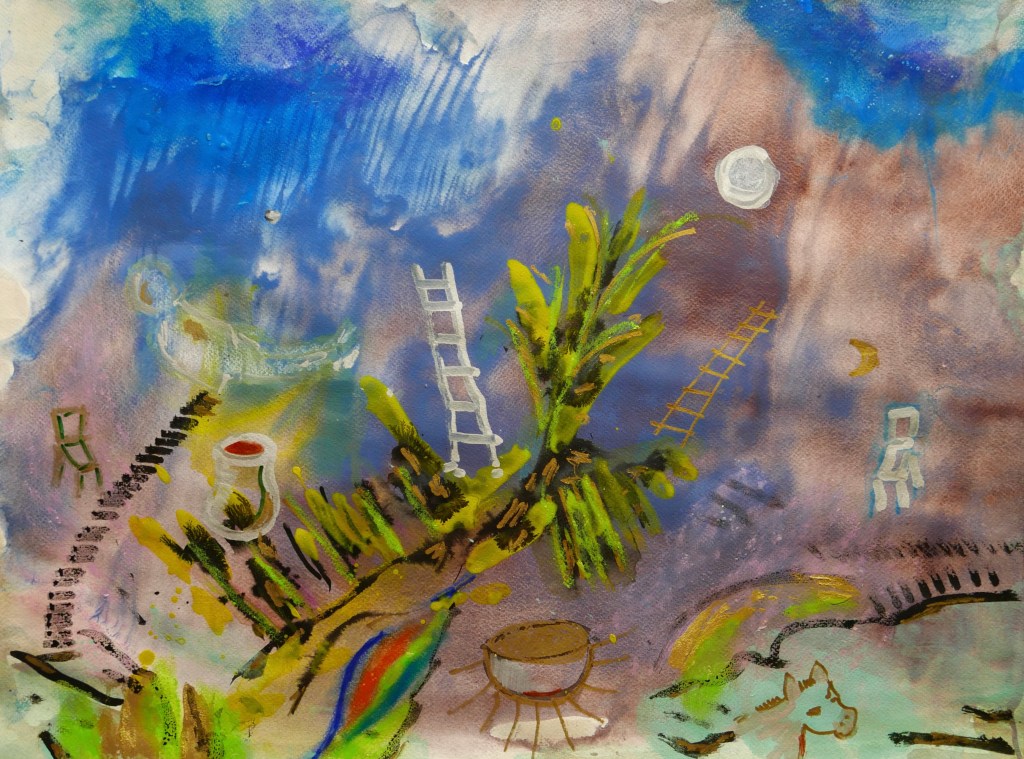
LADDERS
Filene’s department store
near nineteen-fifty-three:
An Aunt Jemima floor
display. Red bandanna,
Apron holding white rolls
of black fat fast against
the bubbling pancakes, bowls
and bowls of pale batter.
This is what Donna sees,
across the “Cookwares” floor,
and hears “Donnessa?” Please,
This can not be my aunt.
Father’s long-gone sister,
nineteen-fifty-three. “Girl?”
Had they lost her, missed her?
This is not the question.
This must not be my aunt.
Jemima? Pays the rent.
Family mirrors haunt
their own reflections.
Ladders. Sisters. Nieces.
As soon as a live Jemima
as a buck-eyed rhesus
monkey. Girl? Answer me.
Elizabeth Alexander
BLUES
I am lazy, the laziest
girl in the world. I sleep during
the day when I want to, ‘til
my face is creased and swollen,
’til my lips are dry and hot. I
eat as I please: cookies and milk
after lunch, butter and sour cream
on my baked potato, foods that
slothful people eat, that turn
yellow and opaque beneath the skin.
Sometimes come dinnertime Sunday
I am still in my nightgown, the one
with the lace trim listing because
I have not mended it. Many days
I do not exercise, only
consider it, then rub my curdy
belly and lie down. Even
my poems are lazy. I use
syllabics instead of iambs,
prefer slant to the gong of full rhyme,
write briefly while others go
for pages. And yesterday,
for example, I did not work at all!
I got in my car and I drove
to factory outlet stores, purchased
stockings and panties and socks
with my father’s money.
To think, in childhood I missed only
one day of school per year. I went
to ballet class four days a week
at four-forty-five and on
Saturdays, beginning always
with plie, ending with curtsy.
To think, I knew only industry,
the industry of my race
and of immigrants, the radio
tuned always to the station
that said, Line up your summer
job months in advance. Work hard
and do not shame your family,
who worked hard to give you what you have.
There is no sin but sloth. Burn
to a wick and keep moving.
I avoided sleep for years,
up at night replaying
evening news stories about
nearby jailbreaks, fat people
who ate fried chicken and woke up
dead. In sleep I am looking
for poems in the shape of open
V’s of birds flying in formation,
or open arms saying, I forgive you, all.
Elizabeth Alexander
FUGUE
Virginia Woolf, incested
though her childhood, wrote
that she imagined herself
growing up inside a grape.
Grapes are sealed and safe.
You wouldn’t quite float
in one; you’d sit locked
in enough moisture to keep
from drying out, the world
outside though gelid green.
Picture everyone’s edges
smudged. Picture everyone
a green as delicate
as a Ming celadon. Pic-
ture yourself a mollusk
with an unsegmented body
in a skin so tight and taut
that you’d be safe. You could
ruminate all night about
the difference between “taut”
and “tight,” “molest” and “incest.”
“Taut means tightly-drawn,
high-strung. What is tight
is structured so as not to
permit passage of liquid
or gas, air, or light.
Elizabeth Alexander
The forsythia cascades quiver
No breeze blowing any where else?
Gazing, again, ah the blossoms
A goldfinch constructing her nest!
Elizabeth Alexander
AT THE BEACH
Looking at the photograph is somehow not
unbearable: My friends, two dead, one low
on T-cells, his white T-shirt an X-ray
screen for the virus, which I imagine
as a single, swimming paisley, a sardine
with serrated fins and a neon spine.
I’m on a train, thinking about my friends
and watching two women talk in sign language.
I feel the energy and heft their talk
generates, the weight of their words in the air
the same heft as your presence in this picture,
boys, the volume of late summer air at the beach.
Did you tea-dance that day? Write poems
in the sunlight? Vamp with strangers? There is
sun under your skin like the gold Sula
found beneath Ajax’s black. I calibrate
the weight of your beautiful bones, the weight
of your elbow, Melvin,
on Darrell’s brown shoulder.
Elizabeth Alexander
Minnesota Fats Describes His Youth
I’ve been eating
like a sultan
since I was two days old.
I had a mother
and three sisters
who worshipped me.
When I was two years old
they used to plop me
in a bed with a jillion
satin pillows
and spray me
with exotic perfumes
and lilac water,
and then
they would shoot me the grapes.
Elizabeth Alexander
Stravinsky in L.A.
In white pleated trousers, peering through green
sunshades, looking for the way the sun is red
noise, how locusts hiss to replicate the sun.
What is the visual equivalent
of syncopation? Rows of seared palms wrinkle
in the heat waves through green glass. Sprinklers
tick, tick, tick. The Watts Towers aim to split
the sky into chroma, spires tiled with rubble
nothing less than aspiration. I’ve left
minarets for sun and syncopation,
sixty-seven shades of green which I have
counted, beginning: palm leaves, front and back,
luncheon pickle, bottle glass, etcetera.
One day I will comprehend the different
grades of red. On that day I will comprehend
these people, rhythms, jazz, Simon Rodia,
Watts, Los Angeles, aspiration.
Elizabeth Alexander
HAIRCUT
I get off the IRT in front of the Schomburg Center for Research in Black Culture after riding an early Amtrak from Philly to get a hair cut at what used to be the Harlem “Y” barbershop. It gets me in at ten to ten. Waiting, I eat fish cakes at the Pam Pam and listen to the ladies call out orders: bacon-biscuit twice, scrambled scrambled fried, over easy, grits, country sausage on the side. Hugh is late. He shampoos me, says “I can’t remember, Girlfriend, are you tender-headed?” From the chair I notice the mural behind me in the mirror. I know those overlapped sepia shadows, a Renaissance rainforest, Aaron Douglas! Hugh tells me he didn’t use primer and the chlorine eats the colors every day. He clips and combs and I tell him how my favorite Douglas is called “Building More Stately Mansions,” and he tells me how fly I’d look in a Salt ‘n’ Pepa ‘do, how he trained in Japan.
Clip clip, clip clip. I imagine a whoosh each time my hair lands on the floor and the noises of small brown mammals. I remember, my father! He used to get his hair cut here, learned to swim in the caustic water, played pool and basketball. He cuts his own hair now. My grandfather worked seventy-five years in Harlem building more stately mansions. I was born two blocks away and then we moved.
None of that seems to relate to today. This is not my turf, despite the other grandfather and great-aunt who sewed hearts back into black chests after Saturday night stabbings on this exact corner, the great-uncle who made a mosaic down the street, both grandmothers. What am I always listening for in Harlem? A voice that says, “This is your place, too,” as faintly as the shadows in the mural? The accents are unfamiliar; all my New York kin are dead. I never knew Fats Waller but what do I do with knowing he used to play with a ham and a bottle of gin atop his piano; never went to Olivia’s House of Beauty but I know Olivia, who lives in St. Thomas, now, and who exactly am I, anyway, finding myself in these ghostly, Douglas shadows while real ghosts walk around me, talk about my stuff in the subway, yell at me not to butt the line, beg me, beg me, for my money?
What is black culture? I read the writing on the wall on the side of the “Y” as I always have: “Harlem Plays the Best Ball in the World.” I look in the mirror and see my face in the mural with a new haircut. I am a New York girl; I am a New York woman; I am a flygirl with a new hair cut in New York City in a mural that is dying every day.
Elizabeth Alexander